
A lot of rebrands shouldn't happen, and a lot of refreshes are too timid to matter. A refresh changes how your brand looks and sounds. A rebrand changes what it stands for, who it serves, or its name. The difference is strategy, not aesthetics, and confusing the two is the fastest way to waste a brand budget. This article shows how to tell them apart, and our free decision tool helps your leadership team make the call.
Most rebrand decisions start with a feeling, not a finding. The website looks dated. A competitor just launched a sharp new identity. A new CEO wants the company to look like where it is going. The leadership team is simply tired of the logo. None of those is a strategy.
Here is the uncomfortable part: the people most eager to change a brand are usually the people who see it most. Executives live with their logo every day. Customers notice it a handful of times a year. Fatigue on the inside is not the same as irrelevance on the outside.
Guess wrong in one direction, and you spend a year tearing down equity that customers, employees, and investors spent decades building. Guess wrong in the other, and you put a fresh coat of paint on a company whose strategy has already moved on, and the market notices.
Both risks are well documented. Strategy scholar Roger Martin argues on HBR On Strategy that customer loyalty rests largely on habit, and that disrupting familiar cues can send a company back to square one. Wharton marketing professor Patti Williams names the opposite risk in Knowledge at Wharton: a new name does not change what is going on inside an organization.
What's Actually Different Between a Refresh and a Rebrand
A brand refresh updates the expression of a brand whose strategy is still right: the logo, color, typography, photography, messaging, and website. A rebrand changes the strategy itself: the positioning, the promise, the audience, the brand architecture, and often the name. Expression follows.
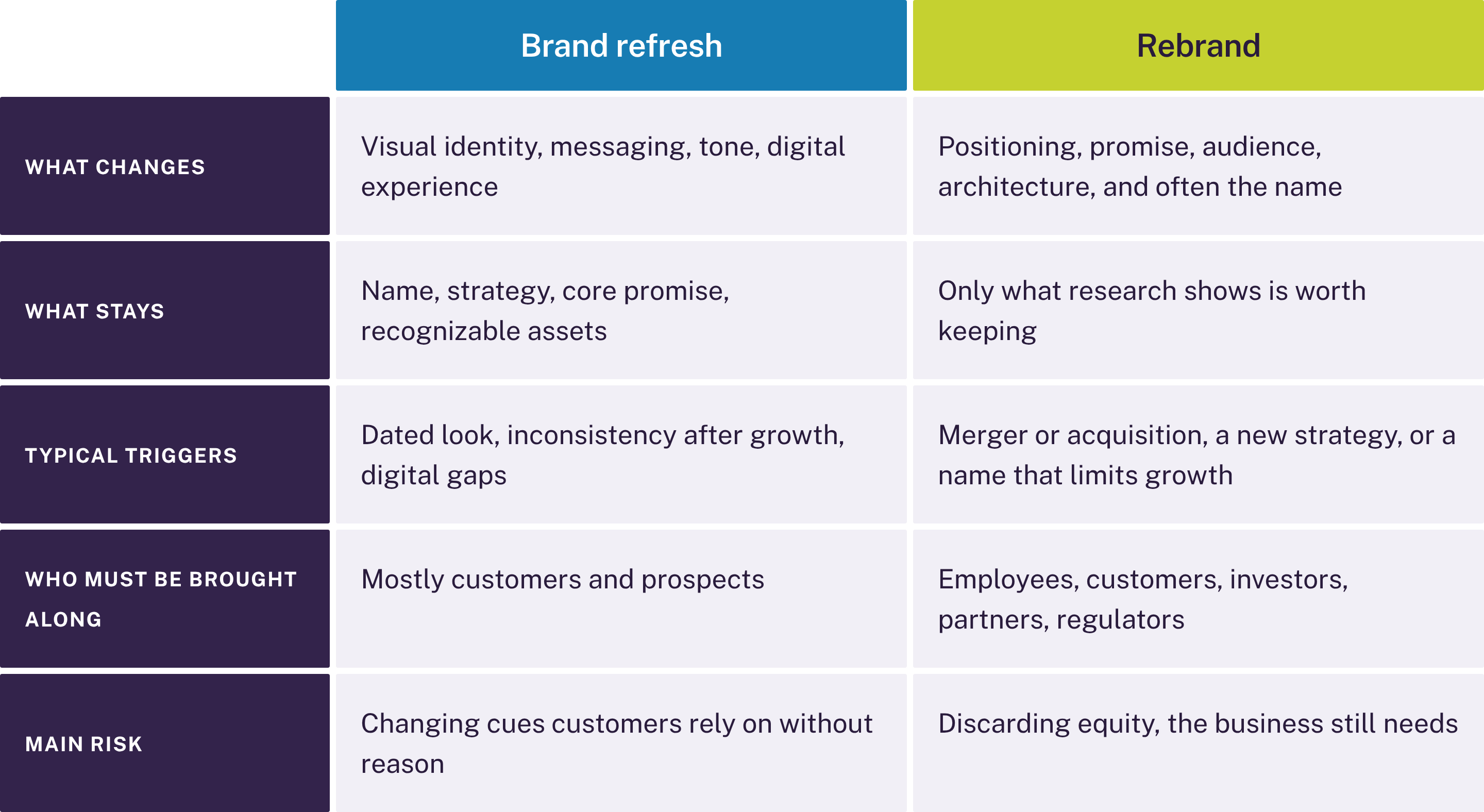
The market reads the two differently. A study of 215 rebranding announcements by Zhao, Calantone, and Voorhees in the Journal of the Academy of Marketing Science separated identity change from strategy change. Investors judged each rebrand on how well its parts fit together and on the firm's competitive context. The market rewards change that matches the need, not change for its own sake.
The Signs You Need a Refresh, Not a Rebrand
If your strategy is sound and your audience is the same, the problem is usually expression.
Common signals:
- Your brand looks older than your company. The business has modernized, but the identity still reflects where you were ten years ago.
- Growth created inconsistency. New locations, service lines, or teams each built their own materials, and no two touchpoints look or sound alike.
- Your sales team has stopped using your materials. When sellers rewrite decks on their own, the messaging has stopped helping them win.
- Your digital presence lags behind your buyers. Forrester's Buyers' Journey Survey, 2025 found 94% of business buyers now use AI in their buying process, and twice as many named generative AI or conversational search as their most meaningful information source than named any other. If people and answer engines can't read your site clearly, that's a refresh problem, not an identity crisis.
- A new offering fits the promise you already make. Extending a trusted brand is almost always cheaper than launching a new one.
- New leadership, same direction. A new CEO, a founder handoff, or a PE-installed team doesn't automatically call for a rebrand. If strategy, customers, and promise stay put, a refresh can signal a new chapter without discarding what works. McKinsey's study of nearly 600 CEO transitions found that at already healthy companies, new CEOs who replaced more than half their direct reports destroyed value. When the business is healthy, evolve the brand rather than overhaul it.
Protecting recognition matters more in B2B than most leaders realize. Joint research from the LinkedIn B2B Institute and the Ehrenberg-Bass Institute shows that most category buyers are out of the market at any given time; 80% of companies, for example, change banking services only once every five years. The buyers you will win over the next few years mostly aren't shopping today. When they return, they need to recognize you.
The discipline of a good refresh is knowing what not to touch. Martin's rule of thumb on HBR On Strategy is useful here: "improved" builds a link to the past, while "new" suggests a break with it. Keep the cues customers use to recognize you and modernize everything around them.
Sometimes the smartest refresh borrows equity you already own. Rice University's business school leaned into the "Rice Business" name after research showed a closer tie to the university would lift awareness, and the school reports national aided awareness grew from 13% to 73%. The strategy didn't change. The most recognizable asset simply moved out front.
When to Rebrand: the Signs You Need the Full Thing
A rebrand is warranted when the brand no longer describes the business. Wharton's Williams identifies three typical triggers: a merger or acquisition that requires a new corporate identity, a shift in strategic direction, and a name that no longer fits. In B2B, the first one deserves the most attention.
Mergers, Acquisitions and Platform Builds
When two companies become one, or a PE sponsor rolls acquisitions into a platform, the question isn't how the brand looks but which brand the combined company should be. McKinsey research on M&A integration shows how often that call is rushed: 80% of companies complete a brand transition within 18 months of close, yet only 40% take a fact-based approach to positioning. It offers four questions to ground the decision:
- Does brand matter in customers' purchasing decisions, or for internal reasons?
- Do the companies' target customer segments overlap?
- How different are the two brands' equities in the overlapping segments?
- How significant are customers' switching costs?
The answers point to one of five outcomes, from keeping brands independent to building an entirely new one. Pace matters too. When Avianca and TACA merged, CEO Fabio Villegas wrote in HBR that the company waited more than three years to put a new face on the combined airline.
We see this pattern in our own work. WillScot unified a portfolio of acquired brands under one platform while aligning internal teams and cultures post-M&A. Allredi merged two fierce competitors into a single market leader across 24 North American locations. For a deeper look at the integration path, see Rebranding Strategy: Building a Brand After an Acquisition.
A New Strategy That the Old Brand Can't Carry
When the business itself transforms, the brand has to follow. Oxy's move from traditional oil and gas toward leadership in carbon management required communicating a different company, not a better-looking one.
New Leadership With a New Mandate
Leadership change belongs on both lists because what matters is the new plan, not the new leader. When a new CEO, a founder's successor, or an incoming PE sponsor arrives with a genuinely different strategy, the brand has to carry that story. McKinsey's analysis of nearly 600 new CEOs found that at underperforming companies, leaders who made four or more strategic moves in their first two years averaged 3.6% excess annual shareholder returns, versus 0.4% for less bold peers. The brand is often the move customers and employees see first.
The test: is the change about the leader's taste or the company's direction? Only the second justifies a rebrand. For more, see Five Reasons to Rebrand.
A Name or Promise That Limits Growth
Some names were right for the company you were. Names tied to a single product, a founder, a region, or an acronym no one outside the building can decode often cap growth once the business outgrows them. Skyward Specialty, formerly HIIG, needed a ground-up rebrand to rise above its limitations and open new markets.
A Portfolio No One Can Navigate
Years of acquisitions, launches, and regional offshoots can leave a tangle of names and sub-brands that confuse buyers and split investment. When customers can't tell how your businesses relate, that's a brand architecture decision, and a rebrand territory. Our branded house vs. house of brands episode walks through the options.
Five Bad Reasons to Rebrand (and One Bad Reason to Refresh)
Some of the most expensive brand decisions start with reasons that sound strategic in the boardroom and fall apart in the market.
- “We're bored with it." Internal fatigue is the most common and least valid trigger. Martin's HBR example is instructive: when Procter & Gamble moved its cold-water Tide from the familiar orange bottle to a cooler blue, the launch struggled until the product went back to orange. Customers weren't tired of orange. They were buying it on habit.
- “The new CEO wants to make a mark." A new leader is a reason to review the brand, not to replace it. If the strategy isn't changing, a rebrand becomes a monument to the transition instead of a tool for the business.
- “Our competitor just rebranded." Their repositioning reflects their strategy, not yours. Reacting to it makes you a follower in the one area where you should be most distinct.
- “We need to get away from our reputation." Wharton's Williams is blunt: a brand name doesn't change what is going on inside an organization. A new name launched to escape an operational problem usually inherits it.
- “The agency said so." We're an agency, so take this seriously: if the only evidence for a rebrand is a creative pitch, you don't have evidence. McKinsey found only 40% of merging companies take a fact-based approach to brand positioning. Insist on research that shows what customers and employees actually value.
And the bad reason to refresh? To avoid a hard strategic conversation. A new logo and website on a company whose strategy has shifted buys a few months of energy and then leaves the real misalignment in place. The market eventually notices the gap between what you say and what you've become.
Stop Treating It as a Binary
Refresh versus rebrand is the right first question, but the best answers often live in between. McKinsey found that 75% of merging companies phase a brand transition in gradually rather than switching all at once.
Lenovo is the classic example. After buying IBM's PC business, it dropped the IBM name in less than two years but kept the ThinkPad brand business customers trusted, going to market as Lenovo ThinkPad. It changed the corporate brand without discarding the product equity that justified the deal.
The middle options are worth taking seriously:
- Endorsed brands. An acquired or legacy name stays in front, with the parent brand as a signature ("a Company X business"), while trust transfers over time.
- Phased migration. The corporate brand changes first; product, location, and fleet assets follow on a set schedule with a firm end date.
- Strategic refresh. The name and core assets stay, but positioning and messaging are rebuilt around a sharpened strategy. It's more than a facelift and less than a new identity.
The discipline is the same in every case: decide what to keep on purpose, not by default.
Get the Decision Tool
Ready to make the call with your leadership team? Rebrand or Refresh? The B2B Decision Tool is a 30-minute exercise that includes a scored self-assessment, a clear read on whether you need a refresh, a rebrand, or neither, situation checks for M&A, PE platform builds, and leadership change, and straight answers to the questions leaders ask most about cost, timing, and search visibility. Download it free.
Make the Call on Evidence, Not Instinct
The right answer isn't always the bigger project. Sometimes it's a disciplined refresh that protects decades of recognition. Sometimes it's a full rebrand that finally lets the brand tell the truth about the business you've become. What matters is making that call on evidence: what your customers still value, what your strategy now demands and what your people can deliver.
If you've decided which path you're on, these are good next reads:
- Building the internal case: How to Get Buy-in for Your Rebrand
- Integrating after a deal: Rebranding Strategy: Building a Brand After an Acquisition
- Seeing the process from the inside: Why We Rebranded: A Step-by-Step Breakdown of the Process
Still Not Sure Which One You Need?
Start with the decision tool, then bring your results to us. BrandExtract has helped B2B companies through mergers, platform builds, leadership transitions, and strategic transformations make this call with research, not guesswork. Talk to our team before anyone opens a design file.
Sources and Further Reading
- Martin, Roger. The Risks of Rebranding. HBR On Strategy, Harvard Business Review, November 2023.
- Villegas, Fabio. First Make It Work, Then Rebrand It. Harvard Business Review, September 2013.
- Williams, Patti. Into the Metaverse: Can Facebook Rebrand Itself? Knowledge at Wharton, November 2021.
- Zhao, Yanhui, Roger J. Calantone, and Clay M. Voorhees. Identity Change vs. Strategy Change: The Effects of Rebranding Announcements on Stock Returns. Journal of the Academy of Marketing Science 46, 2018.
- Liu, Alex, et al. Integrating Marketing and Brand in M&A: The Way to Superior Growth. McKinsey & Company, March 2020.
- Birshan, Michael, Tom Meakin, and Kurt Strovink. How New CEOs Can Boost Their Odds of Success. McKinsey Quarterly, May 2016.
- Heath, Ty. The 95-5 Rule. LinkedIn B2B Institute, with research from the Ehrenberg-Bass Institute.
- Forrester. B2B Buyers Make Zero-Click Buying Number One. Forrester Blogs, January 2026.
- Rice Business. Our Brand. Rice University, accessed September 2026.