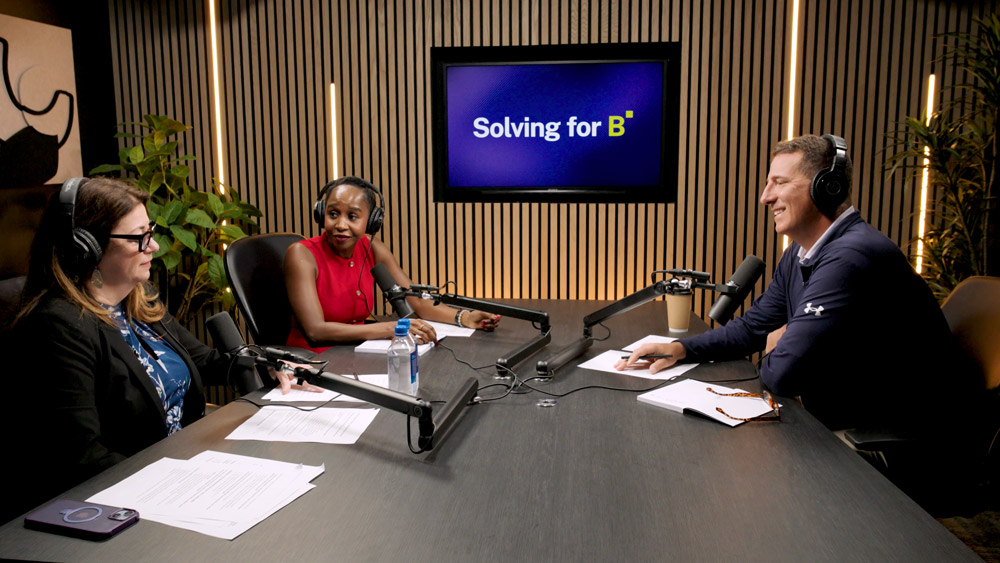
On this episode of Solving for B, BrandExtract CEO Bo Bothe, COO Dr. Charity Ndisengei and Director of Account Management Laura Paddock take on one of marketing's most persistent debates: brand or performance? Their answer is that it was never a choice. Brand and demand are one growth system running on two clocks, and it only works when corporate strategy, brand, marketing and sales stay connected. They discuss where that chain most often breaks, why brand is usually the first budget cut, and what CEOs should see when it all works.
Table of Contents
- Is There Really a Difference Between Brand and Performance Marketing?
- Why Is Brand the First Thing Cut?
- Where Does the Chain from Strategy to Sales Break Down?
- What Should CEOs Expect When Brand and Demand Work Together?
Episode Transcript
*This transcript has been edited for clarity and readability.
Q: Is There Really a Difference Between Brand and Performance Marketing?
Bo: As we prepped for this, we talked about performance marketing versus brand marketing, and Charity told me a while back there's no difference.
Charity: To put it more eloquently, it's not a competition. They're not two separate things; they're part of one system. Clients have heard me talk about brand over time and sales overnight. Demand marketing converts the need that exists right now. Brand creates trust so we can convert demand at a later stage. It's one growth system running on two different clocks.
Bo: What we've seen over the last few years is clients getting to the last mile on a website, and the CEO looks at it and says, "That's not what we do." Why isn't corporate strategy understood across the organization? Why isn't it attached to brand, brand attached to marketing, and marketing attached to sales and measurable results, whether that's enterprise value or profitable revenue?
Charity: Everyone does brand. You either do it on purpose by investing in it, or you do it by discounting your product. Investing in brand compounds in value over time. Not investing erodes your pricing, so you keep discounting or keep paying more for leads. You can't sustainably keep paying for leads and run a profitable business.
Key Takeaways:
- Brand and demand marketing aren't competing priorities; they're one growth system on two timelines
- Demand marketing converts today's need, while brand builds the trust that converts future demand
- Every company does brand, either by investing in it or by discounting to make up for it
- Relying on leads alone drives acquisition costs up and margins down over time
Real insight goes well beyond a single discovery meeting
Q: Why Is Brand the First Thing Cut?
Laura: Brand is often seen as how we present ourselves to the marketplace rather than how we win, so it feels like a vanity initiative. In one recent engagement, senior executives were generous with their time, their strategy was clear, and we built a complex brand architecture for a portfolio of brands selling into different markets, with a three-to-five-year exit plan. The CEO was thrilled. Then it was time to roll it out, and they said, "We'll take it from here." The internal launch was scaled back, the performance marketing systems never went in, and the break in the chain came down to investment. It was almost a performance penalty for doing such a good job.
Bo: Charity, is that a budget problem or a commitment problem?
Charity: The lack of commitment drives the budgeting problem. Strategy is driven from the top. If leadership doesn't see the value, people aren't driven in the direction they should be. Setting direction, accountability and budget sits at the CEO's level, not marketing's.
Charity: But as marketers, we also need to talk about the commercial value of what we do. If we don't tie our activity back to commercial value, we'll keep having conversations about budgets being cut. Our role is to grow the business and support strategy, not just make pretty pictures.
Charity: A 2017 study from the Ehrenberg-Bass Institute looked at companies that cut brand spending. Within the first year, revenue dropped 16%. By the second year, the losses were much steeper. Established brands coasted for a year or two; smaller brands felt it almost immediately. Your customer base turns over constantly, and especially in B2B, where people aren't buying every day, you need to have built that trust before they're ready to buy.
Key Takeaways:
- Brand gets cut first when leaders see it as presentation rather than a driver of growth
- Budget problems usually start as commitment problems at the top
- Marketers need to frame their work in commercial terms: pricing power, margin protection, lower cost of growth and future demand
- Research shows cutting brand investment leads to revenue declines, especially for smaller brands
- Brand ensures you're top of mind when infrequent B2B buyers are ready to buy
Q: Where Does the Chain from Strategy to Sales Break Down?
Bo: Corporate strategy to brand, brand to marketing, marketing to sales. All of it needs to work in concert, with a system that shows what's working. If an executive or marketer is listening, where are the biggest breaking points?
Charity: Treating them as separate functions. Marketing builds trust, tells the brand's story and gives people a reason to choose you. Sales closes the deal. Imagine having to introduce yourself and build trust from scratch every time you sell. When the two work hand in glove, a salesperson walks in and the customer already knows who you are. It shortens the path from introduction to sale. I have clients where sales won't share CRM contacts with marketing. How are we supposed to nurture those leads or stay top of mind if we're never allowed to talk to them?
Laura: Another obvious breakdown is when we've translated leadership's strategy into a brand everyone has embraced, built the marketing materials to empower sales, and then every salesperson builds their own pitch deck and value proposition. It's no longer aligned with what we all agreed on. We also see a push and pull between subject matter experts and the salespeople who hear from customers every day. The content has to be accurate and elevated, but customers also need to understand it.
Bo: There's a point where you have to land the plane. Trust the process. We had a long-time client who kept pushing to change their tagline. In B2B especially, you get tired of it before the market has even absorbed it. Change it too soon and you just confuse the market. It takes patience and discipline to stick with the system.
Charity: That's where demand marketing comes in; it's the landing of the plane. Telling great stories is one half. Closing the deal is the other half of the growth system, and they have to work hand in glove.
Key Takeaways:
- The biggest failure point, and the biggest opportunity, is the handoff between marketing and sales
- Shared CRM data and lead nurturing keep your brand top of mind through long B2B buying cycles
- Off-brand pitch decks and one-off value propositions undo alignment the leadership team agreed on
- Changing messaging before the market absorbs it creates confusion; consistency takes discipline
Q: What Should CEOs Expect When Brand and Demand Efforts Work Together?
Charity: People choose your brand over others, and you grow continually, recession or not. Internally, the organization is more aligned. Everyone is clear on where the business is going, what you do, and which decisions do and don't fit the strategy.
Laura: Sales conversations become more of a partnership focused on fit and solving the customer's challenges, and pricing pressure isn't part of the conversation. And everyone in the workforce can describe what we do and why it matters.
Charity: That sounds simple, but when we interview a client's staff about the organizational strategy, everyone often has a different answer, even in the C-suite. If leadership isn't aligned, imagine the frontline people meeting your customers every day. That's how your brand is actually experienced.
Bo: When sales and marketing talk, you can also improve the product: which services matter, which ones to cut.
Charity: And which value proposition to lead with. Customers evolve, and new competitors emerge. When sales feeds that back, you can pivot. Brands that have lasted hundreds of years didn't do it by staying the same.
Bo: If you were advising a CEO on day one of this journey, what's the one thing to get right?
Laura: Validate and build on the vision through voice-of-the-customer interviews. They make sure leadership's direction is grounded in what customers, recruits and target audiences actually need.
Charity: Understand this won't change things overnight. It's an investment and a long-term game, and it starts from the top. If you keep moving the goalposts or your investment, you won't see the benefits. You can drive demand and close sales along the way, but you can't do one without the other. It's a system you invest in over time.
Key Takeaways:
- Signs of success include being chosen over competitors more often and more predictable, repeatable growth
- Internal alignment means everyone, from the C-suite to the front line, can explain what you do and why it matters
- Feedback from sales helps refine the value proposition, services and product
- Voice-of-the-customer research grounds leadership's vision in what the market needs
- Brand and demand are a long-term commitment that has to be owned by the CEO
Get More Brand Strategy Insights
Want to learn more about connecting your brand to growth? Explore our insights library for more conversations on brand, marketing and business strategy, and subscribe to our newsletter to get the latest episodes of Solving for B delivered to your inbox.